Wissenschaft und Technologie
Entdecken Sie die Möglichkeiten der KI-gestützten Deep-Data-Lösungen von lifespin für das Gesundheitswesen.
Unsere innovative KI-Plattform kombiniert fortschrittliche Metabolomik und NMR-Analytik, um präzise metabolische Einblicke zu ermöglichen und die personalisierte Prävention zu revolutionieren.
So funktioniert es
Von der Probenentnahme bis zu umfassenden metabolischen Erkenntnissen
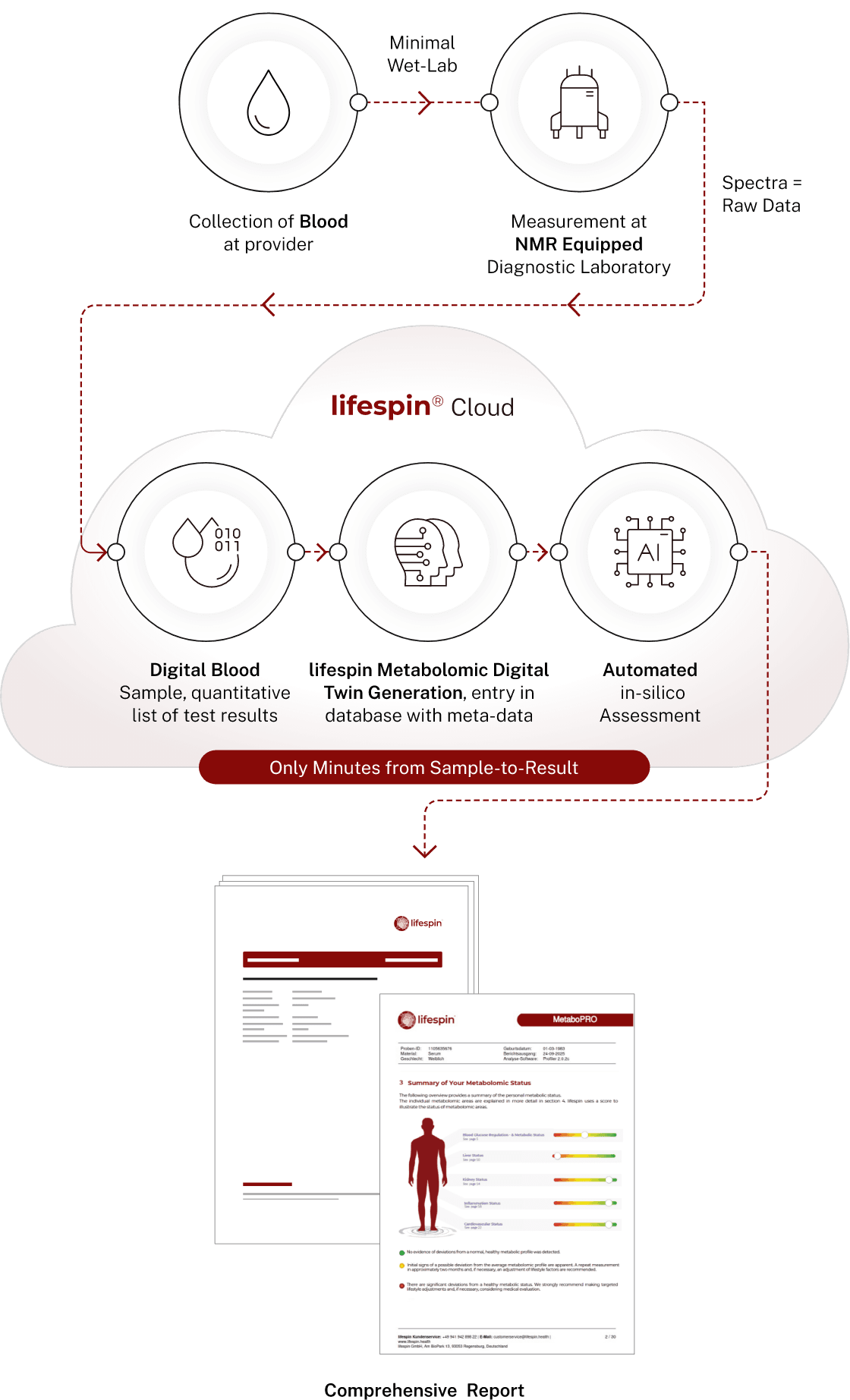
lifespins Technologie verwandelt eine kleine Blutprobe mithilfe eines einfachen Workflows und hochentwickelter Algorithmen in umfassende metabolische Erkenntnisse. So funktioniert der Prozess von der Probenentnahme bis zur Erstellung des Berichts:

Probenentnahme:
Es wird eine kleine Blutprobe entnommen.
NMR-Analyse:
Die Blutprobe wird mittels NMR (Kernspinresonanzspektroskopie) analysiert, um quantitative und umfassende metabolomische Daten zu erfassen – möglich in jedem NMR-Labor weltweit.
Datenverarbeitung:
Die NMR-Daten werden verarbeitet, um eine quantitative Ergebnisliste für hunderte Parameter zu erstellen.
KI-Analyse & Erstellung eines digitalen Profils:
Die firmeneigenen Algorithmen von lifespin extrahieren aus den Messdaten Informationen zu den Konzentrationen der einzelnen Metaboliten und erstellen daraus das metabolomische Profil.
Auf Basis des metabolomischen Profils und der zugehörigen Metadaten ermitteln die firmeneigenen KI-Modelle von lifespin den metabolischen Status.
Erstellung des Berichts:
Es wird ein detaillierter Bericht mit Bewertungen für die verschiedenen Stoffwechselbereiche erstellt.
Der Workflow von lifespin stellt sicher, dass jeder einzelne Schritt sorgfältig konzipiert ist, um präzise Gesundheitsinformationen in Echtzeit bereitzustellen und so ein proaktives und personalisiertes Gesundheitsmanagement ermöglicht.
lifespin Cloud
Umfassende und personalisierte Erkenntnisse auf Knopfdruck
Die lifespin Cloud bietet eine Reihe innovativer Funktionen, die umfassende und personalisierte Erkenntnisse für medizinisches Fachpersonal, Kliniker und Labore liefern.
Wichtige Funktionen:
Benutzerfreundliche Oberfläche:
Die lifespin Cloud bietet eine intuitive Benutzeroberfläche, über die medizinische Fachkräfte einfach auf die verfügbaren Tools zugreifen und diese nutzen können. Gleichzeitig ermöglicht sie Laboren weltweit, auf die Technologie von lifespin zuzugreifen und sie einzusetzen.
Cybersicherheit, Datensouveränität und Datenschutz im Mittelpunkt:
Die lifespin Cloud wird innerhalb der EU gehostet und erfüllt strenge Anforderungen an Cybersicherheit und Datenschutz mit einer sicheren, isolierten Umgebung für jeden Kunden.
Direkte Anbindung über eine API:
Kunden können ihre Systeme über standardisierte APIs direkt anbinden und so vollständig digitale und nahtlose Workflows realisieren.
Einfacher Zugriff auf alle lifespin-Produkte und -Berichte:
Rufen Sie die Ergebnisse direkt aus der Cloud ab und exportieren Sie sie als standardisierte PDF-Dateien oder in individuell anpassbaren Formaten, die auf Ihre Anforderungen zugeschnitten sind.

Werden Sie Teil der Revolution der personalisierten Prävention.
Erleben Sie die Kraft KI-gestützter Stoffwechselerkenntnisse und machen Sie den nächsten Schritt in Richtung proaktives Gesundheitsmanagement.
Demo anfragen:
Erleben Sie die lifespin Cloud in Aktion und entdecken Sie, wie es Ihren Ansatz im Gesundheitswesen verändern kann.
Registrieren:
Werden Sie Teil der lifespin B2B-Community für Gesundheitsdienstleister und erhalten Sie Zugang zu innovativen metabolischen Erkenntnissen.
Kontaktieren Sie uns:
Kontaktieren Sie uns für weitere Informationen oder um mögliche Partnerschaften zu besprechen.
Die nächste Welle der Innovation – KI und Deep-Data-Integration
Fortschrittliche KI und umfassende Daten für präzise Gesundheitsversorgung
KI-gestützte Analyse:
Unsere KI-Modelle werden anhand von Hunderttausenden NMR-Spektren trainiert, um die komplexen Muster in metabolomischen Daten zu verstehen.
Die KI-Engine wird gezielt für spezifische Anwendungsbereiche optimiert, etwa zur Beurteilung des allgemeinen Gesundheitszustands und der Organfunktion sowie zur Diagnose von Erkrankungen, zur Bestimmung des Krankheitsstadiums und zur Beurteilung des Therapieansprechens.
Umfangreiche Datenbank
Die hochgradig kuratierte, firmeneigene Datenbank von lifespin umfasst mehr als 275,000 + menschliche Profile, darunter Profile gesunder und erkrankter Personen aus mehr als 800 + Krankheitsbereichen. Damit bietet sie eine fundierte Referenz für die Beurteilung und Überwachung des Gesundheitsstatus.
Generative KI für individuelle Berichte:
lifespin entwickelt generative KI-Tools für detaillierte, personalisierte Berichte.
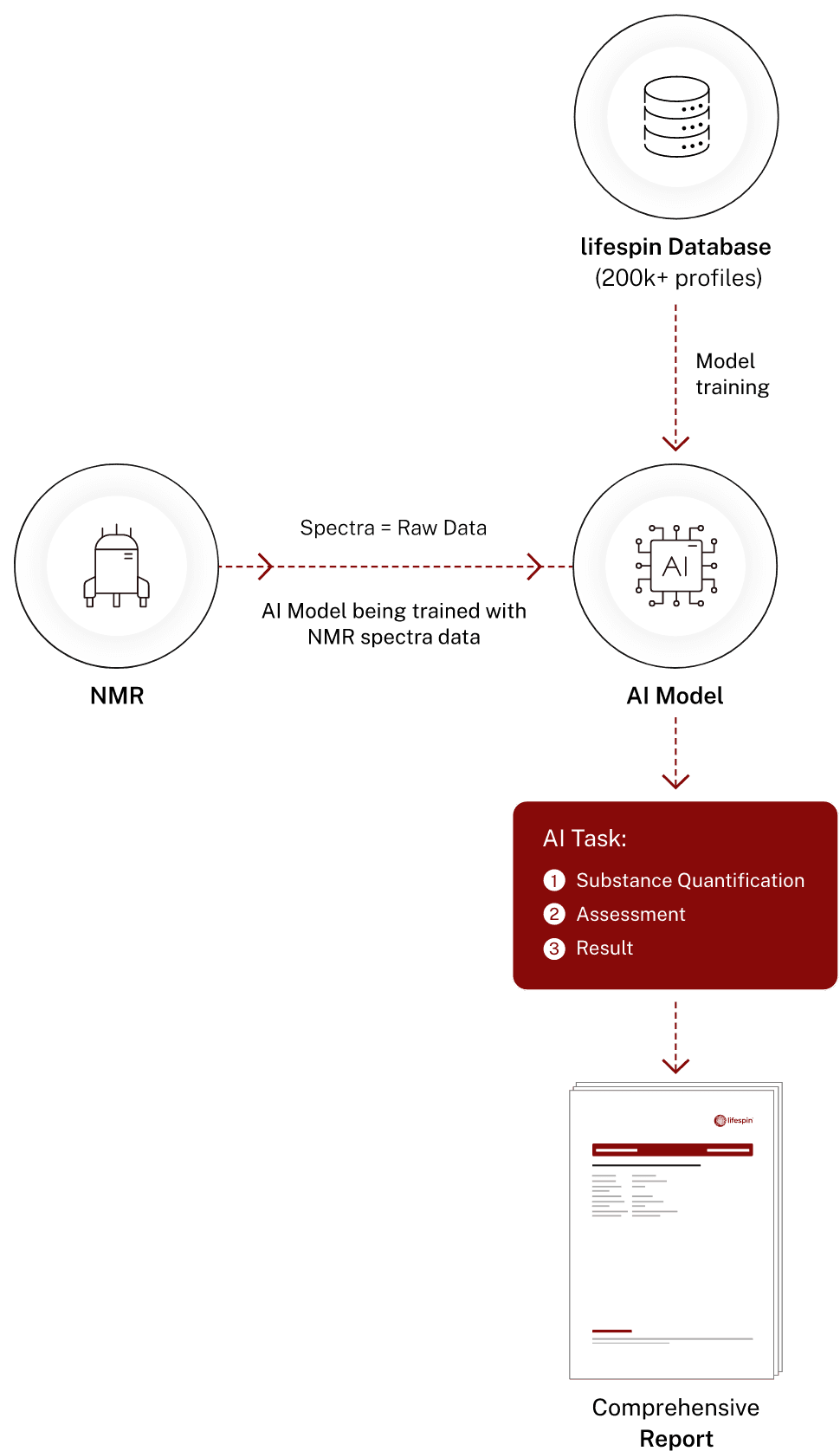
Die Integration von KI und Deep Data bei lifespin ermöglicht hochpräzise, personalisierte und handlungsrelevante Erkenntnisse und verändert damit die Art und Weise, wie Gesundheit überwacht und gemanagt wird.
Das digitale Gesundheitsprofil
Verwandlung von Blutproben mithilfe von KI-Modellen in digitale metabolomische Profile
Im Mittelpunkt der Technologie von lifespin steht die Erstellung eines digitalen metabolomischen Profils, das eine präzise Darstellung des individuellen Gesundheitszustands eines Patienten in Echtzeit ermöglicht. Durch den Einsatz fortschrittlicher, KI-gestützter Metabolomik und NMR-Analytik kann lifespin Daten aus Blutproben in konkrete Erkenntnisse für die Gesundheitsversorgung überführen.
Der Schlüssel zu proaktivem Gesundheitsmanagement
Veröffentlichungen
Unser interdisziplinäres Team engagierter Wissenschaftlerinnen und Wissenschaftler blickt auf zahlreiche wissenschaftliche Publikationen zurück. Darüber hinaus befinden sich weitere Veröffentlichungen in Vorbereitung. Für weitere Informationen können Sie uns jederzeit gerne kontaktieren.
2026
Health benefits of a five-day at-home modified fasting program: a randomised controlled trial
Genome Medicine 2026, 18, 80
A 5‑day modified fasting program can safely induce beneficial metabolic changes, improving weight, blood sugar, inflammation, and well‑being, although these effects are mostly temporary.
2026
Metabolomics-Enhanced Liquid Biopsy Identifies Early Heptocellular Injury in Females with MetALD
International Journal of Molecular Sciences 2026, 27, 11
A multimodal, sex-stratified study combining metabolomics, CSC markers, and MELD reveals a distinct high-risk female MetALD phenotype and may improve early detection and risk stratification of SLD progression.
2026
Twelve-Week Intermittent Hypoxia Intervention in Multiple Sclerosis – A Safety and Feasibility Trial.
A 12‑week repetitive continuous hypoxia intervention was safe and feasible in people with progressive multiple sclerosis, with no clinical, radiological, or laboratory deterioration and with exploratory signals of functional improvement alongside changes observed in serum metabolomic profiles.
2026
Pitfalls of onco-metabolomics: impact of sample integrity on metabolomic investigations in more than 4500 human serum samples from ten different cohorts.
2025
Elevated high-density lipoprotein levels following acute graft-versus-host disease onset: a potential link to T-cell dysfunction and increased relapse risk
Clinical and Translational Immunology 2025, 14: e70060
In this study, lipoprotein profiling revealed that patients with acute graft-versus-host disease had elevated early post-transplant HDL levels, which were associated with delayed T-cell re-normalisation and increased effector-memory CD8⁺ T-cells, findings mirrored in vitro by HDL-induced reductions in healthy donor T-cell proliferation and activation, suggesting that high HDL may impair graft-versus-leukaemia efficacy through T-cell modulation and thereby increase relapse risk.
2025
Metabolic Phenotype and Gender May Predict Treatment Outcomes of Atezolizumab in Extensive-Stage Small Cell Lung Cancer
Translational Lung Cancer Research 2025, 14 (9).
In the study of Small Cell Lung Cancer it was found that women had the greatest survival benefit from adding atezolizumab medication, and that optimal BMI and uric acid levels, female sex, lower LDH, and specific metabolite profiles may serve as predictors of better immunotherapy response.
2025
Dysregulation of amino acid and lipid metabolism in patients with spondyloarthritis
Journal of International Medical Research 2025; 52, 2
This study reveals that patients with spondyloarthritis (SpA), including ankylosing spondylitis and psoriatic arthritis, show distinct metabolic changes—especially in amino acid and lipid metabolism—with glucose and glycerol levels helping to differentiate between the two conditions, offering new avenues for diagnosis and understanding disease mechanisms.
2025
Therapeutic Drug Monitoring of Piperacillin: Agreement between Quantitative Nuclear Magnetic Resonance Spectroscopy and Liquid Chromatography with Tandem Mass Spectrometry.
Clinica Chimica Acta 2025, 577, 120448.
In the study evaluating NMR vs isotope-dilution LC–MS/MS for piperacillin measurement in plasma, the authors report good concordance (concordance correlation coefficient ≈ 0.895, slope ≈ 1.03, intercept ≈ –0.50 mg/L), a small negative bias (–0.85 mg/L), and wide limits of agreement (−18.67 to +16.97 mg/L), suggesting that NMR may be a promising alternative for therapeutic drug monitoring.
2025
Metabolomics for Distinguishing Cardiovascular Risk in Rheumatoid Arthritis Across Different Disease-Modifying Antirheumatic Drug Therapies.
Journal of Clinical Medicine Research 2025, 17 (2), 89–96.
In this study with 200 rheumatoid arthritis patients there were no clear metabolite differences linked to disease activity or treatment, but that metabolic abnormalities were strongly tied to cardiovascular risk factors — in particular, people reporting high stress (“distress”) showed abnormal histidine metabolism, suggesting histidine levels might serve as a biomarker of CV risk.
2024
Comprehensive Analysis of the Cerebrospinal Fluid and Serum Metabolome in Neurological Diseases.
Journal of Neuroinflammation 2024, 21 (1), 234.
Using NMR spectroscopy and machine learning, this study analyzed 99 metabolites in cerebrospinal fluid and serum to accurately distinguish multiple sclerosis, Parkinson’s disease, and other neurodegenerative disorders—with Parkinson’s patients showing notably lower CSF propionic acid levels, highlighting a potential biomarker for diagnosis.
2026
NMR-based leaf metabolome profiling in segregating populations of Taraxacum kok-saghyz reveals environmental and genetic effects on rubber content and root biomass
Industrial Crops and Products 2026, Volume 249.
Both environment and genetics shape rubber dandelion metabolism, but growing conditions have the biggest impact on rubber yield, guiding future breeding efforts.
2026
The Transition from Winter to Spring Has an Impact on the Airway Metabolome Profile of Asthmatic Horses.
PLOS ONE 2026, 21, e0346250
Seasonal changes, especially the transition from winter to spring, strongly influence airway metabolism in horses with equine asthma, with the most pronounced effects seen in severe disease.
2026
Identification and Quantification of Dandelion Metabolites by NMR for the Characterization and Differentiation of Dandelion Germplasm.
Journal of Plant Physiology 2026, 320, 154739
NMR‑based metabolomics clearly shows that Russian and common dandelions have organ‑ and species‑specific chemical profiles, especially in roots, providing a foundation for finding biomarkers to support rubber‑producing dandelion breeding.
2022
Sufficient Potassium Supply Enhances Tolerance of Potato Plants to PEG-Induced Osmotic Stress.
Plant Stress 2022, 5, 100102.
This 15-week study showed that low potassium worsens osmotic (drought-like) stress in potato cultivars by triggering metabolic changes, while adequate potassium boosts growth and helps plants recover better—demonstrating potassium’s key role in drought resilience.
2022
Effects of Atherogenic Diet Supplemented with Fermentable Carbohydrates on Metabolic Responses and Plaque Formation in Coronary Arteries Using a Saddleback Pig Model.
PLOS ONE 2022, 17 (10), e0275214.
In this 15-week pig study, an atherogenic diet caused clear metabolic* changes and increased blood lipids compared to a conventional diet, but adding pectin or inulin didn’t improve metabolic profiles or reduce early-stage coronary plaque development, highlighting the diet’s strong impact despite fiber supplements.
2022
An Equine Model for Vaccination against a Hepacivirus: Insights into Host Responses to E2 Recombinant Protein Vaccination and Subsequent Equine Hepacivirus Inoculation.
Viruses 2022, 14 (7), 1401.
In an animal model study vaccination with the EqHV E2 protein did not prevent infection in ponies, but those vaccinated cleared the virus sooner, had lower viral peaks, recovered faster from liver damage, mounted earlier antibody responses, and showed quicker normalization of liver metabolism* and less sustained inflammatory activation.
2021
Cultivation Systems, Light Intensity, and Their Influence on Yield and Fruit Quality Parameters of Tomatoes.
Agronomy 2021, 11 (6), 1203.
This study shows that double-glazed greenhouses reduce tomato growth and quality due to lower light transmission, but adding LED interlighting can partially restore yield, improve metabolic composition*, hence sweetness, and nutritional value—highlighting how glazing and lighting choices directly impact both the quantity and quality of tomato production.
2021
Morphological and Metabolite Responses of Potatoes under Various Phosphorus Levels and Their Amelioration by Plant Growth-Promoting Rhizobacteria.
International Journal of Molecular Sciences 2021, 22 (10), 5162.
This plant breeding study showed that phosphorus deficiency causes huge drops in potato height and biomass (60‑80 %) plus metabolic stress* (big changes in sugars, amino acids, organic acids), but inoculation with plant growth promoting rhizobacteria boosted root & shoot growth, root length, and root surface area by ~ 32‑45 %, helping plants better cope with P shortage.
*Gemessen und analysiert mithilfe der lifespin-Technologie